
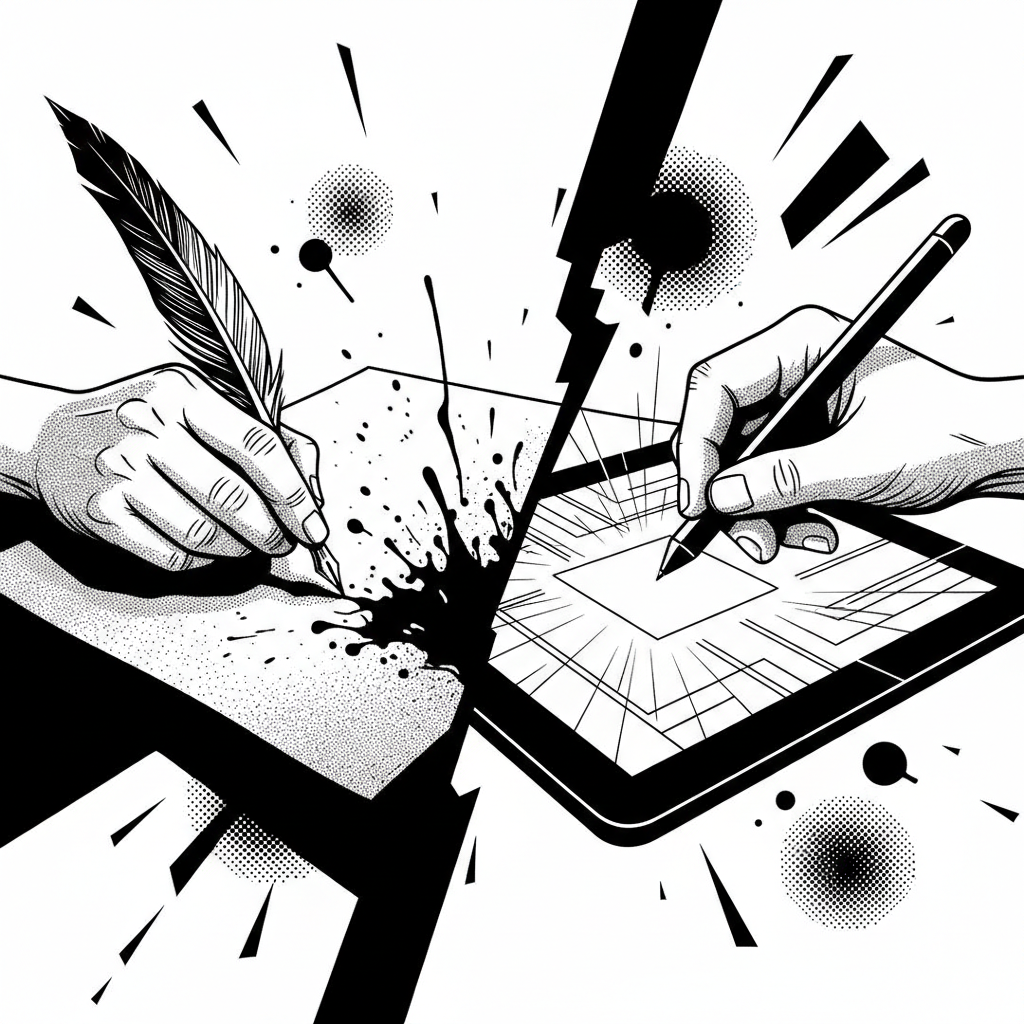
The Evolution: From Paper to Screen
The Legacy of Traditional Drawing
Manual techniques like pencil, ink, and watercolor have long defined comic creation. These methods demanded significant investment in time and space, with their own material and logistical constraints. Every mistake required a complete restart.
Early Digital Forays
Rudimentary drawing software marked the first attempts at digital integration, impacting inking and coloring. Creators welcomed these novelties with a mix of skepticism and enthusiasm, gradually discovering the advantages of computer-assisted creation.
The Rise of Professional Tools
The advent of more powerful and intuitive graphics tablets and software facilitated the democratization of digital creation. This technological evolution paved the way for the first fully digital workflows, radically transforming how comic books are made.
🚀 Launch Your Comic Project
Transform your ideas into captivating pages with our intuitive tools.
Discover Bulle.aiCurrent Digital Tools for Comic Creation
The digital landscape today offers a plethora of sophisticated tools that transform every stage of comic creation. These technologies enable unprecedented flexibility and efficiency, while opening the door to creative experimentation.
| Creation Stage | Tools and Benefits |
|---|---|
| Concept and Scriptwriting | Scriptwriting software, mind-mapping tools to structure the plot and characters. Saving and reusing ideas for an optimized workflow. |
| Drawing and Sketching | Graphics tablets, vector and raster drawing software offering precision and responsiveness comparable to traditional methods, with undo and duplication functions. |
| Coloring and Layout | Advanced coloring tools, layer management, texture libraries, and layout software for a professional look and visual consistency. |
| Image Generation and Iteration | Artificial intelligence to generate visual concepts, backgrounds, or characters, and quickly iterate on creative ideas. |
| Export and Publishing | Multiple export formats for print and web, facilitating the distribution and publication of the final work. |
| Creative Collaboration | Real-time sharing tools, collaborative comments, and version control for creative teams. |
🎨 Streamline Your Workflow
Accelerate the creation of your characters and scenes with innovative solutions.
Explore FeaturesImpact and Future: Comics in the Digital Age
Comparison of Creative Workflows
The adoption of digital tools has profoundly changed how comics are created, offering significant advantages in speed, flexibility, and creative possibilities compared to traditional methods.
| Process Aspect | Traditional Workflow | Digital Workflow |
|---|---|---|
| Sketching and Layout | Pencil on paper, manual correction, frequent redrawing | Graphics tablet, undo tools, layers for variations, quick adjustments |
| Inking | Pen, brush, markers on paper, risk of permanent errors | Digital tools simulating ink, precise line control, easy correction |
| Coloring | Watercolor, gouache, markers, long and potentially costly process | Digital tools, unlimited palettes, layer management, special effects, speed |
| Layout and Lettering | Manual cutting, pasting, hand-lettering or with printed fonts | Dedicated software, digital fonts, customizable speech bubbles, easy adjustment |
| Corrections and Modifications | Difficult, costly in time and materials, risk of degrading the original artwork | Simple and fast, without quality alteration, ability to revert to previous versions |
Conclusion
The transition from traditional drawing to digital comics is not just a matter of tools, but a true transformation of the creative process. Current technologies, including artificial intelligence, offer creators unprecedented possibilities to bring their ideas to life faster and with greater artistic freedom. Embracing these innovations means staying at the forefront of comic creation and pushing the boundaries of sequential art. Ready to transform your vision into a work and create a comic book like never before?